
The treatment of hematological malignancies with Chimeric Antigen Receptor (CAR) T-cell therapies has, in many cases, shown powerful, inducing, long-lasting effects. However, while CAR T-cell therapies are indeed a promising new therapy that treats hematological malignancies by harnessing the power of the immune system to target and destroy cancer cells, results in the treatment against solid tumors has been less successful. Now a new approach could treat solid tumors more efficiently.
Thanks to a recent study from Dan Cappabianca and Krishanu Saha at the Wisconsin Institute for Discovery (WID) ePublished in Molecular Therapy – Methods & Clinical Development, Chimeric Antigen Receptor (CAR) T-cell therapy can be improved by altering the conditions the T-cells are grown in. And this new approach was discovered entirely by chance.[1]
Specific conditions
T-cells are white blood cells crucial for the immune system’s response to infections and cancer. They can be modified with CRISPR/Cas9 genome editing technology to express a specific receptor that redirects their natural ‘killing instincts‘ toward targeting cancer cells, specifically those in tumors.[2]
One unique feature of T-cells is that they can ‘remember’ a pathogen after first exposure, allowing a quicker and stronger response if this pathogen is encountered again. This is similar to how vaccines train the immune system to recognize and fight off specific pathogens.
But for the cells to be used as a robust cancer treatment, they must be made in specific conditions in the lab.
“We were comparing two distinct T-cell media formulations with varying nutrient levels,” noted Cappabianca.
“Interestingly, our breakthrough came entirely by chance. I inadvertently placed the cells in the wrong medium, which unexpectedly became the focal point of my entire thesis,” Cappabianca said.
Metabolic priming
In the body, T-cells develop from stem cells in the bone marrow. In the lab, researchers activate the T-cells in a nutrient-deficient medium with low concentrations of glucose and glutamine which the cells need for energy. Then they move them to a high-nutrient medium. The first step stresses the cells and triggers specific processes that can enhance their ability to target tumors, promote the formation of T-memory cells, and select the more resilient cells that can survive with such low levels of energy. The second step supports rapid growth and T-cell multiplication.
The result of this metabolic priming is that treated cells retain their stem cell-like qualities, thus enhancing their ability to kill cancer cells, transform into durable memory cells, and survive longer in the body.
“We discovered that by briefly restricting sugar exposure, akin to a three-day ‘keto diet,’ our T-cells showed reduced maturity at the end of the manufacturing process. The less mature they are when reinfused into a patient, the longer they live fighting cancer,” Cappabianca explained.
The two-step process also appeared to help with cell memory. In CAR T-cell therapy, boosting these memory properties helps T-cells better recognize and combat cancer over time.
High-risk neuroblastoma
In recent phase 1 / 2 studies researchers in Italy investigated the role of immunotherapy with CAR expressing T-cells that target the disialoganglioside GD2 expressed on tumor cells may be a therapeutic option for patients with high-risk neuroblastoma, the most common extracranial solid tumor in children responsible for 11% of all deaths from cancer in the pediatric population.[3]
In the study, the investigators enrolled patients (1 to 25 years of age) diagnosed with relapsed or refractory, high-risk neuroblastoma in order to test autologous, third-generation GD2-CAR T-cells expressing the inducible caspase 9 suicide gene (GD2-CART01). [4]
Using these lab-grown T-cells in this new approach, 63% of patients experienced a partial or complete reduction in tumors for a time.[3] In comparing the study outcomes from a variety of studies, the investigators noticed an improvement from clinical trials using CAR T-cells that were not grown with the lab’s two-step process where just 15% of patients experienced a partial or complete reduction in tumors after treatment.
Adapting for large-scale manufacturing
More research is needed to understand the key factors that help these CAR T-cells live longer and become effective against solid tumors. Looking ahead, researchers hope that this process of ‘metabolically priming‘ these specific kinds of CAR T-cells can be adapted for large-scale manufacturing with the ultimate goal of treating patients within the next few years.
“A famous aphorism by French chemist Louis Pasteur is that ‘chance favors only the prepared mind,’” noted Saha.
“Our unplanned media switch — really by chance — led us on a new path of discovery.”
__
Clinical trials
Anti-GD2 CAR T Cells in Pediatric Patients Affected by High Risk and/or Relapsed/Refractory Neuroblastoma or Other GD2-positive Solid Tumors ClinicalTrials.gov ID NCT03373097
Reference
[1] Cappabianca D, Pham D, Forsberg MH, Bugel M, Tommasi A, Lauer A, Vidugiriene J, Hrdlicka B, McHale A, Sodji QH, Skala MC, Capitini CM, Saha K. Metabolic priming of GD2 TRAC-CAR T cells during manufacturing promotes memory phenotypes while enhancing persistence. Mol Ther Methods Clin Dev. 2024 Apr 10;32(2):101249. doi: 10.1016/j.omtm.2024.101249. PMID: 38699288; PMCID: PMC11063605.
[2] Researchers Develop Advanced Gene Editing Techniques to Boost T Cells in Cancer Treatment. Wisconsin Institute for Discovery (WID). Online, Last accessed on July 5, 2024
[3] Richards RM, Sotillo E, Majzner RG. CAR T Cell Therapy for Neuroblastoma. Front Immunol. 2018 Oct 16;9:2380. doi: 10.3389/fimmu.2018.02380. PMID: 30459759; PMCID: PMC6232778.
[4] Del Bufalo F, De Angelis B, Caruana I, Del Baldo G, De Ioris MA, Serra A, Mastronuzzi A, Cefalo MG, Pagliara D, Amicucci M, Li Pira G, Leone G, Bertaina V, Sinibaldi M, Di Cecca S, Guercio M, Abbaszadeh Z, Iaffaldano L, Gunetti M, Iacovelli S, Bugianesi R, Macchia S, Algeri M, Merli P, Galaverna F, Abbas R, Garganese MC, Villani MF, Colafati GS, Bonetti F, Rabusin M, Perruccio K, Folsi V, Quintarelli C, Locatelli F; Precision Medicine Team–IRCCS Ospedale Pediatrico Bambino Gesù. GD2-CART01 for Relapsed or Refractory High-Risk Neuroblastoma. N Engl J Med. 2023 Apr 6;388(14):1284-1295. doi: 10.1056/NEJMoa2210859. PMID: 37018492.
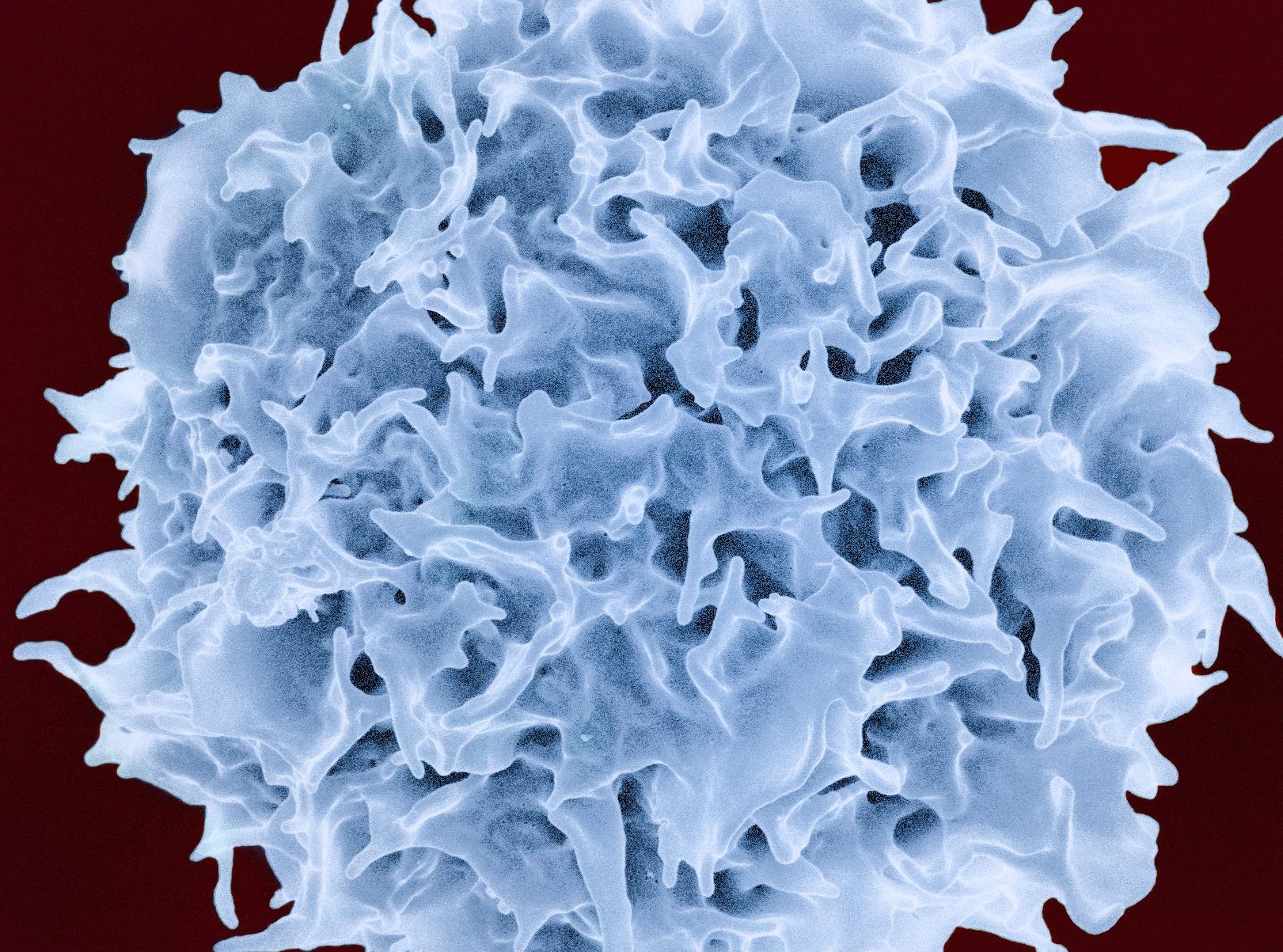
Featured image: T Lymphocyte/ Colorized scanning electron micrograph of a T-ymphocyte. Photo courtesy: © 2010 – 2024 NIAID. Used with permission
DOI