

Investigators at St. Jude Children’s Research Hospital have shown in preclinical models that deleting a single inhibitory gene from CAR T-cells improves their ability to control osteosarcoma and prevent lung metastases, a major cause of death in children with relapsed disease. The findings, published August 25, 2026, in Cell Reports Medicine, are being used to support development of an early-phase clinical trial [1].
Key Takeaways
- Deleting Regnase-1 from B7-H3-directed CAR T cells improved tumor control and prevented lung metastasis in mouse models of osteosarcoma. The edited cells also enabled long-term rejection of a subsequent tumor challenge [1].
- The effects extended beyond the CAR T cells themselves. Regnase-1 deletion altered the tumor microenvironment, increasing interferon-gamma-producing T and NK cells while reducing immunosuppressive M2-like macrophages [1].
- Human Regnase-1-deleted B7-H3 CAR T cells manufactured using a clinical-grade process showed strong antitumor activity in an orthotopic human osteosarcoma model, supporting further development toward a first-in-human trial in patients with sarcoma [1].

An Unmet Need in Relapsed Pediatric Bone Cancer
Osteosarcoma is the most common primary bone malignancy in children and adolescents. While combination chemotherapy and surgery have improved outcomes for newly diagnosed, localized disease, survival for patients with relapsed or metastatic osteosarcoma has changed little in decades. Pulmonary metastasis remains a major cause of mortality.
CAR T-cell therapy has transformed treatment for CD19- and BCMA-positive blood cancers, but its effectiveness against solid tumors, including osteosarcoma, has been limited. One major challenge is the tumor microenvironment, the local tissue surrounding a tumor, which can suppress T-cell function and weaken the antitumor response even when CAR T cells recognize their target.
Targeting a Ribonuclease That Restrains T-Cell Function
The St. Jude group, led by Stephen Gottschalk, MD, PhD, chair of the Department of Bone Marrow Transplantation & Cellular Therapy, and Hongbo Chi, PhD, chair of the Department of Immunology, focused on Regnase-1, a ribonuclease that helps restrain immune responses. Earlier work from the same group and others showed that deleting Regnase-1 in tumor-specific CD8-positive T cells increases their persistence, enhances expression of effector molecules, and improves oxidative metabolism, effects mediated in large part by the transcription factor BATF [2,3].
In the new study, the researchers used CRISPR-Cas9 gene editing to delete Regnase-1 in CAR T-cells directed against B7-H3 (CD276), a surface antigen expressed across a range of pediatric and adult solid tumors, including osteosarcoma. Naive CD8-positive T cells from Cas9-transgenic mice were engineered to express both the B7-H3-targeting receptor and the gene-editing machinery. The researchers then tested the cells in two independent genetically engineered mouse models of osteosarcoma and in a Lewis lung carcinoma model to determine whether the approach also worked beyond B7-H3-positive bone tumors [1].
Durable Tumor Control and Prevention of Lung Metastasis
Across the models, Regnase-1-deleted B7-H3 CAR T-cells controlled tumor growth and prevented pulmonary metastatic colonization more effectively than conventional, unedited B7-H3 CAR T-cells, improving survival in treated mice.
In a human xenograft model using an orthotopic tibial implantation technique, only Regnase-1-deleted human B7-H3 CAR T cells reliably induced regression of the primary tumor and prevented lung metastases. Conventional CAR T cells, non-transduced T cells, and CAR T cells with a non-functional receptor did not achieve comparable tumor control.
Mice that survived long term rejected a second tumor challenge introduced months after the original T-cell infusion, indicating that the edited cells retained antigen-specific memory after the initial treatment [1].
Reprogramming the Tumor’s Immune Landscape
One of the study’s key findings was that Regnase-1 deletion affected more than the CAR T cells themselves. Using flow cytometry and single-cell RNA sequencing of lung tissue from tumor-bearing mice, the investigators found that Regnase-1-deleted CAR T cells altered the tumor immune environment.
The frequency of endogenous, non-CAR interferon-gamma-producing CD4-positive and CD8-positive T cells and natural killer cells increased, while immunosuppressive M2-like macrophages decreased. At the same time, M1-like macrophages increased; these cells are generally associated with proinflammatory and antitumor activity. Single-cell transcriptomic analysis of macrophage subpopulations showed a shift away from tumor-promoting gene signatures following treatment with the edited CAR T cells [1].
Adeleye Adeshakin, PhD, the study’s first author, described the findings as evidence that the modified cells did more than resist suppression themselves. They also activated other immune cells within the tumor and altered the local immune environment.
Notably, combining Regnase-1-deleted CAR T cells with PD-L1 checkpoint blockade did not produce additional antitumor benefit. The investigators had expected that the combination might improve efficacy because PD-1 and PD-L1 were upregulated on treated and endogenous immune cells. The lack of additional benefit was consistent with the limited activity reported for checkpoint blockade combined with CAR T-cell therapy in other preclinical and early clinical settings [1].
From Mouse Models to a Manufacturing-Ready Human Product
For clinical development, the team adapted a current Good Manufacturing Practice-compatible process to generate Regnase-1-deleted human B7-H3 CAR T cells from healthy donor leukapheresis products. The process used lentiviral transduction to introduce the CAR construct, followed by CRISPR-Cas9 ribonucleoprotein electroporation to delete Regnase-1.
Gene editing did not alter the T-cell subset composition of the final product or baseline expression of the exhaustion markers TIM-3 and PD-1. Off-target editing analysis using a genome-wide sequencing method did not identify unintended cutting sites [1].
Gottschalk said the findings support viewing osteosarcoma, and cancer more broadly, as a systemic disease rather than one confined to the tumor. He also noted that engineered T cells capable of affecting the broader immune response may be needed to improve outcomes for children with these malignancies.
What Remains to Be Established
Several questions remain before the approach can enter clinical testing. The study was conducted in mouse models and in human cell products tested in xenografts; it does not establish safety, dosing, or efficacy in pediatric patients.
The investigators also found that Regnase-1-deleted CAR T cells expanded robustly but did not show improved long-term persistence compared with control cells. The reason for this finding remains unclear and will require further study.
Another limitation is that the study did not use lymphodepleting chemotherapy before CAR T-cell infusion, which is a standard component of many clinical CAR T-cell protocols. The antitumor effects observed in immune-competent mice may therefore differ from those seen when lymphodepletion is used, and the authors identify this as an area for further investigation.
Finally, although tumor regression occurred without evidence of B7-H3 antigen loss, the mechanisms underlying eventual tumor progression in immune-competent models were not fully characterized.
The St. Jude team, through its Center of Excellence for Pediatric Immuno-Oncology, is developing an early-phase clinical trial to evaluate Regnase-1-deleted B7-H3 CAR T cells in patients with sarcoma [1].
References
[1] Adeshakin AO, Shi H, Perry SS, Sheppard H, Nguyen P, Sun X, Zhou P, Métais JY, Cunningham T, Kc A, Tian L, Peche V, Prater MS, Langfitt DM, O’Reilly C, Park JJ, Chabot A, Zhou S, Matsubara A, Lee G, Tsai SQ, Pruett-Miller SM, Talbot LJ, Yustein JT, Krenciute G, DeRenzo C, Chi H, Gottschalk S. Targeting Regnase-1 in B7-H3-CAR T cells reprograms the tumor microenvironment and enhances antitumor efficacy for osteosarcoma. Cell Rep Med. 2026 Aug 25:103008. doi: 10.1016/j.xcrm.2026.103008. Epub ahead of print. PMID: 42641597.
[2] Wei J, Long L, Zheng W, Dhungana Y, Lim SA, Guy C, Wang Y, Wang YD, Qian C, Xu B, Kc A, Saravia J, Huang H, Yu J, Doench JG, Geiger TL, Chi H. Targeting REGNASE-1 programs long-lived effector T cells for cancer therapy. Nature. 2019 Dec;576(7787):471-476. doi: 10.1038/s41586-019-1821-z. Epub 2019 Dec 11. PMID: 31827283; PMCID: PMC6937596.
[3] Zheng W, Wei J, Zebley CC, Jones LL, Dhungana Y, Wang YD, Mavuluri J, Long L, Fan Y, Youngblood B, Chi H, Geiger TL. Regnase-1 suppresses TCF-1+ precursor exhausted T-cell formation to limit CAR-T-cell responses against ALL. Blood. 2021 Jul 15;138(2):122-135. doi: 10.1182/blood.2020009309. Erratum in: Blood. 2022 Mar 24;139(12):1925-1926. doi: 10.1182/blood.2021015167. PMID: 33690816; PMCID: PMC8288655.
[4] St. Jude Children’s Research Hospital. Removing immune ‘brake’ improves CAR T-cell therapy for osteosarcoma. Press release. August 25, 2026.
This article is intended for informational purposes for healthcare professionals and does not constitute medical advice. The therapy discussed here is investigational, has been evaluated only in preclinical animal and xenograft models to date, and is not approved by the FDA or any regulatory authority.
This article was first published on September 6, 2024, in Onco’Zine.
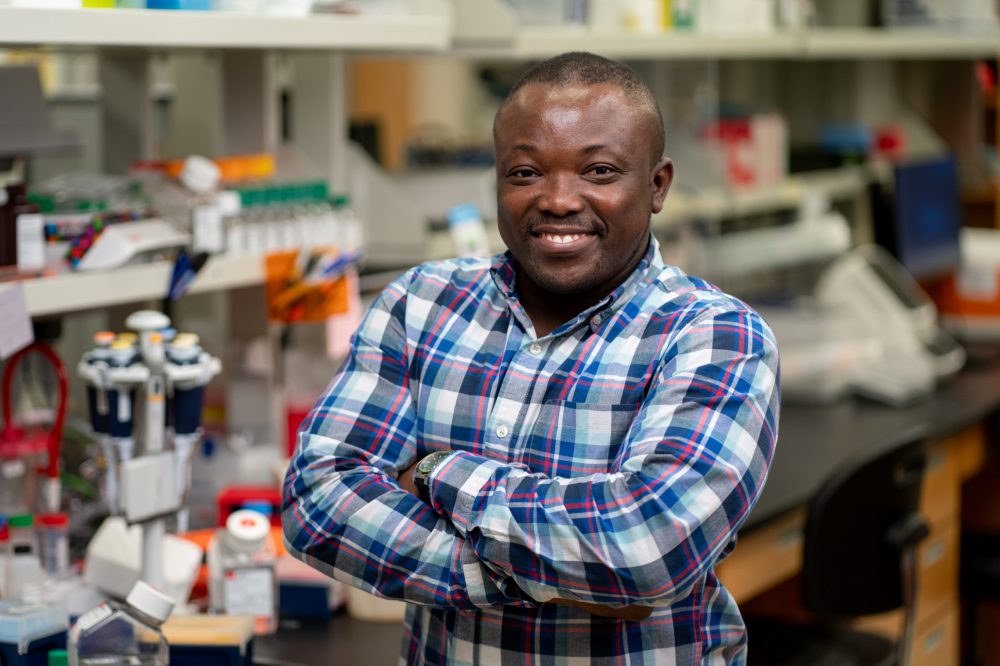
Featured image: First author Adeleye Adeshakin, PhD, St. Jude Children’s Research Hospital, Department of Bone Marrow Transplantation & Cellular Therapy.
DOI